
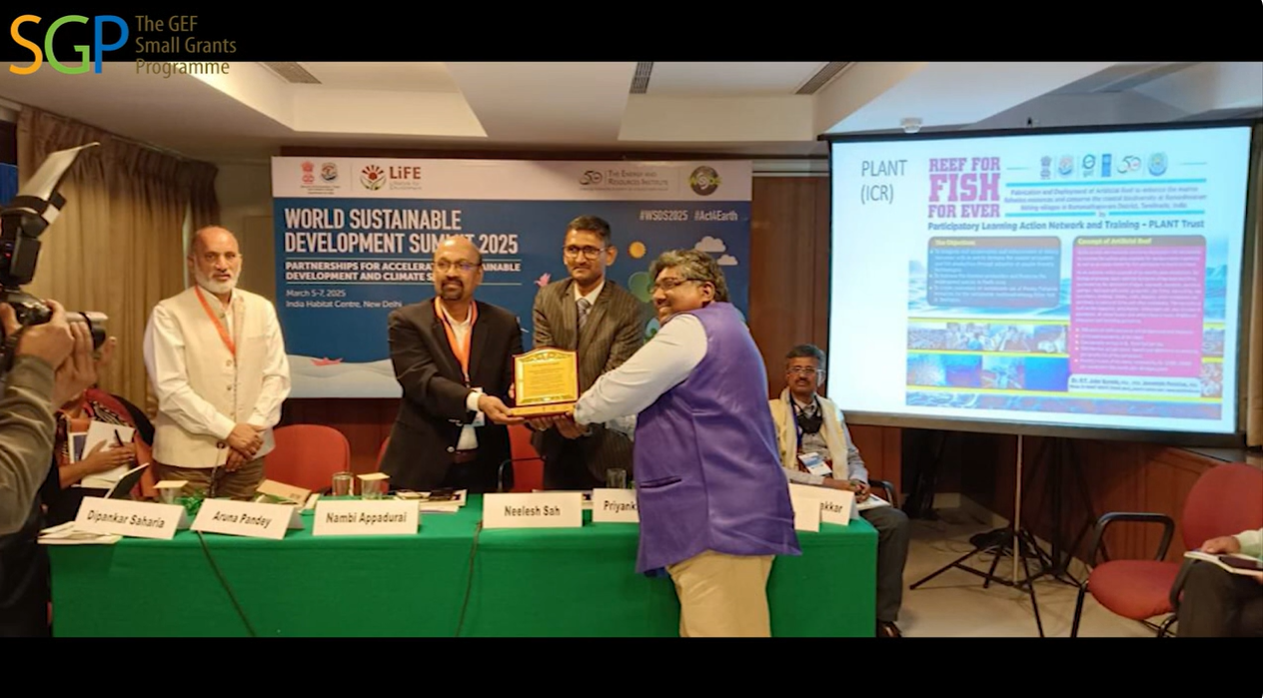
Community-Led Artificial Reef Restoration in Palk Bay
- March 30, 2026
A transformative chapter has begun along the pristine shores of Rameshwaram. With the support of the MoEF&CC–GEF Small Grants Programme (SGP), implemented by UNDP India and coordinated by TERI, 300 scientifically designed artificial reef modules have been deployed nearly 3 nautical miles off the Palk Bay coast to restore marine biodiversity and strengthen the livelihoods of traditional fishing communities.
Led by PLANT Trust, this initiative builds on a strong legacy of over 5,000 artificial reef modules deployed across Tamil Nadu. The deployment ceremony was graced by distinguished officials from the Forest Department, Fisheries Department, TERI, and UNDP SGP India, reflecting robust institutional and community collaboration.
Once submerged, the artificial reefs rapidly transform barren seabeds into vibrant underwater ecosystems—supporting the growth of algae, seaweeds, corals, crustaceans, and abundant fish populations within months. These reef zones now provide safer fishing grounds, reduced fuel costs, and increased incomes for fishermen and fisherwomen across Erakadu, Karaiyur, Kudiyiruppu, Mangadu, Olaikuda, Serankottai, Vadakadu, and Sembai.
Over the next five years, the reef buffer zones will cover 948.63 hectares, support more than 50 tons of marine species, and function as Indigenous Community Conservation Areas (ICCAs)—contributing directly to SDG 14 (Life Below Water) and SDG 13 (Climate Action).
Economic, ecological, and community-driven, this initiative stands as a beacon of hope for coastal sustainability and future generations. It is a powerful example of how small grants lead to big change—where marine conservation strengthens livelihoods, community stewardship protects biodiversity, and local action builds long-term climate resilience.
Watch how coastal communities in Rameshwaram are restoring marine ecosystems and securing their future through nature-based, community-led solutions.
youtube: https://www.youtube.com/watch?v=xF41TsEUt0A
Led by PLANT Trust, this initiative builds on a strong legacy of over 5,000 artificial reef modules deployed across Tamil Nadu. The deployment ceremony was graced by distinguished officials from the Forest Department, Fisheries Department, TERI, and UNDP SGP India, reflecting robust institutional and community collaboration.
Once submerged, the artificial reefs rapidly transform barren seabeds into vibrant underwater ecosystems—supporting the growth of algae, seaweeds, corals, crustaceans, and abundant fish populations within months. These reef zones now provide safer fishing grounds, reduced fuel costs, and increased incomes for fishermen and fisherwomen across Erakadu, Karaiyur, Kudiyiruppu, Mangadu, Olaikuda, Serankottai, Vadakadu, and Sembai.
Over the next five years, the reef buffer zones will cover 948.63 hectares, support more than 50 tons of marine species, and function as Indigenous Community Conservation Areas (ICCAs)—contributing directly to SDG 14 (Life Below Water) and SDG 13 (Climate Action).
Economic, ecological, and community-driven, this initiative stands as a beacon of hope for coastal sustainability and future generations. It is a powerful example of how small grants lead to big change—where marine conservation strengthens livelihoods, community stewardship protects biodiversity, and local action builds long-term climate resilience.
Watch how coastal communities in Rameshwaram are restoring marine ecosystems and securing their future through nature-based, community-led solutions.
youtube: https://www.youtube.com/watch?v=xF41TsEUt0A